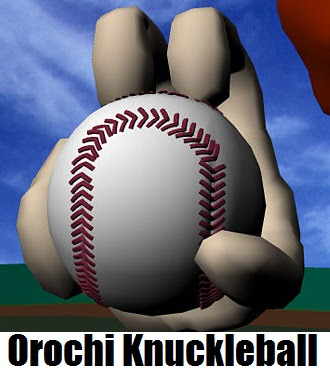
Switch pitcher in Japan works on throwing a knuckleball

Orochi Kunckler

Well spring has arrived in Japan and out of the winter cave the very unique baseball player has come out of his slumber.  Here on Coaching a Switch Pitcher we have covered the trails and tribulations of switch pitching and switch hitting in Japan. Rafe Milo, nicknamed Orochi, has upped the ante in his original abilities with the addition of his version of a knuckler.
Rafe has been working on the pitch for years, but until this month the control had not been stable. The search for a breaking ball, like the use of two arms to pitch, was meant to avoid damage, as much of the conventional wisdom is not to learn most breaking balls before one has a reached an adult bodily maturity. Otherwise there is a higher chance in increased damage to youthful arms.

Read More

source: Coaching a Switch Pitcher

Comments

Popular posts from this blog

Pitchers Glove Rules - Size and Color

What are the rules on a pitchers glove? According to the official baseball rules, a pitchers glove can be up to 12 inches in size , of any weight , and any color except white or gray as long as it is not distracting.  The Akadema ABX-00 glove, pictured above, is 12 inches,  solid black and is not distracting according to local umpires. Little League Rules Gray glove is not allowed for pitching  White glove is not allowed for pitching Little League Rule 1.14: Each fielder, other than the first baseman and the catcher may wear a glove not more than 12 inches long nor more than 7 3/4 inches wide, measured from the base of the thumb crotch to the outer edge of the glove. The glove may be of any weight. Little League Rule  1.15 (a) : The pitcher's glove may not, exclusive of the piping, be white or light gray, nor, in the judgment of an umpire, distracting in any manner. (source: Little League Baseball Rules Regarding Bats and Gloves ...

Fastball Velocity - How fast do kids throw?

How fast does a Little League pitcher throw? The average fastball is between 50-60 mph for a  pitcher in the Majors division of Little League (11-13 yo). Pitchers in the Little League World Series throw fastballs 60-70+ mph. Only a few pitchers touched 70+ mph in 2015 and 2016. One man-child hit 81 mph on the radar. This velocity is almost unhittable from 46 feet  and extremely rare for a 13 year old. #18 RHP Carlos Gonzalez - Panama 79-81 mph fastball  105 mph MLB equivalent reaction time #18 RHP Jaekyeong Kim - South Korea 75-76 mph fastball #19 RHP Ryan Harlost - Mid-Atlantic, Endwell, NY 71-74 mph fastball Threw a complete game to win the 2016 Little League World Series Loreto Siniscalchi , a 6'1" pitcher from Canada, threw in the mid 70s and completely dominated the hitters from Japan.  He led Team Canada to its first victory over Japan in 18 years. Big right-hander Isaiah Head from Kentucky threw 70-73 mph fastballs. His recor...

How Henry Knight learned to throw with both hands

Henry Knight - Ambidextrous Pitcher Switch pitcher Henry Knight - Columbia City Reds, Seattle Switch pitcher Henry Knight was a starter on varsity for four years in high school. He threw six different pitches, for strikes with both arms, and posted a league best 12:1 Strikeout-to-Walk ratio . Coaches and umpires couldn't tell if he was a natural righty or lefty. This post is about Henry's experience learning to throw with both arms since he was 9 years-old. This was a challenge that he thought would be fun, so his parents supported his choice. Reason for Switch Pitching:  Just for fun How he got started: A natural righty, Henry Knight started throwing left-handed when he turned 9-years-old. As a Seattle Mariners fan, he was inspired by LHP Jamie Moyer, who kept batters off-balance by changing speed and location. He threw a slow "Bugs Bunny changeup" that made the best hitters look silly. Moyer was  fun to watch. Henry thought that it would ...